Pet Surgery Services in Oconomowoc, WI
Procedures We Perform
The most common soft tissue surgeries that Oconomowoc Animal Hospital performs are spays, neuters, tumor removals, cystotomies, abdominal exploratories, enterotomies in the case of a foreign body, entropion repairs, and eyelid tumor removals.
Spaying and Neutering
Spaying and neutering support your dog’s or cat’s long-term health, and the procedure will not change your pet’s personality. We spay and neuter dogs and cats here.
By neutering your pet, you’re reducing or eliminating his risk for prostate and testicular cancer, as well as sexually transmitted diseases. Neutering will also reduce or eliminate undesirable behavior, including roaming, fighting, humping, and spraying. Castration, which involves removing the testicles, is also performed under anesthesia.
If you have an exotic pet you would like to have spayed or neutered, we are happy to refer you to a different local clinic. Pet microchipping is often done at the same visit, while your pet is already under anesthesia.
If you are struggling with the decision of whether to spay or neuter your pet, please call us so we can discuss your concerns.
Mass Removals
Probably the most common soft tissue surgery performed on pets is the removal of masses, or lumps. Some of these masses, once removed and tested, are found to be benign; however, occasionally they are more serious. Early removal and accurate diagnosis of a mass are necessary to improve the outcome in your pet if the mass is cancerous.
Bladder Stones and Cystotomy
The most immediate concern for a pet with bladder stones is that the urinary opening may get obstructed as the animal attempts to pass the stones. This is largely a problem in male dogs and cats, and the results can be life-threatening, including uremic poisoning or bladder rupture. In such cases, the veterinarian will try to dislodge the stone, flushing it back into the bladder until surgery can be performed.
A cystotomy is a surgical procedure to remove stones from the bladder. Bladder stones are irritating to the bladder simply by rubbing on the tender lining, which causes bleeding, chronic bladder infections, and urinary frequency or accidents due to pain and discomfort.
After surgery, we send the stones out to a laboratory to have them analyzed. This helps our veterinarians determine which therapeutic diet will work best for your pet to prevent any future bladder stones.
Abdominal Exploratory and Enterotomy
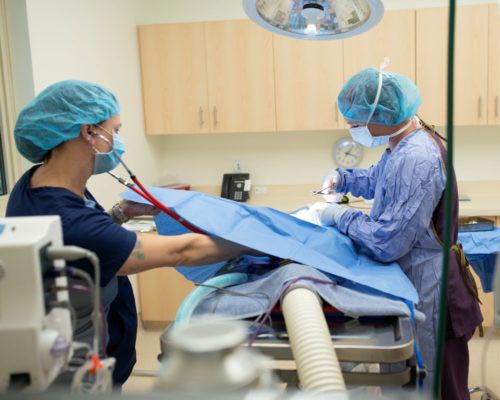
There are many reasons your pet may need a surgical abdominal exploratory. Sometimes pets eat things that they shouldn’t — socks, corn on the cob, rocks, rubber bands — and get a gastrointestinal obstruction. To remove these
gastrointestinal foreign bodies, an incision is made in the intestines at the site of the obstruction. This procedure is called an enterotomy. The foreign body is removed, and the intestines are surgically repaired.
Another reason your pet may need a surgical abdominal exploratory is to do a general exam of your pet’s entire abdomen. This includes looking at the stomach, intestines, and colon in their entirety, and a gross exam of the liver, spleen, kidneys, bladder, abdominal lymph nodes, and the omentum. If abnormal areas are seen, a surgical biopsy can be done. These samples are then sent to a histopathologist for evaluation. The results (for example, whether cells are inflammatory or cancerous) help our veterinarians recommend any additional treatment.
Eye Surgery
Surgery can also help resolve several problems related to the eyes. Tearing in your pet’s eyes can mean an infection is present, or may be a sign that the cornea, the outer layer of the eye, has been damaged. Surgery may allow the cornea to heal faster with less scarring, improving your pet’s ability to see. In some pets, the eyelashes may actually damage the cornea. Surgical intervention improves comfort in these pets, reduces the chances of corneal scarring, and enhances the pet’s vision in the long term.
Surgical eyelid tumor removals are also performed at Oconomowoc Animal Hospital. Sometimes dogs and cats develop tumors on their eyelid. These tumors can be irritating to the cornea if they are rubbing, and when the animal rubs, it can cause the tumor to break open and bleed. Even if an eyelid tumor is not causing the animal a problem, the look of it can be bothersome to pet owners. These tumors can be surgically removed, and once the incision is healed, the result is very cosmetic.
Orthopedic and Complex Cases
For orthopedic repairs or complicated soft tissue surgeries, we are happy to work with Dr. Javier Gallegos, a traveling board-certified surgeon, on an as-needed basis. Dr. Gallegos comes to us and performs procedures here alongside our team.
We also refer to specialists in Waukesha, the Milwaukee area, and the Madison area — see Emergency & Specialist Referrals.
Anesthesia and Monitoring
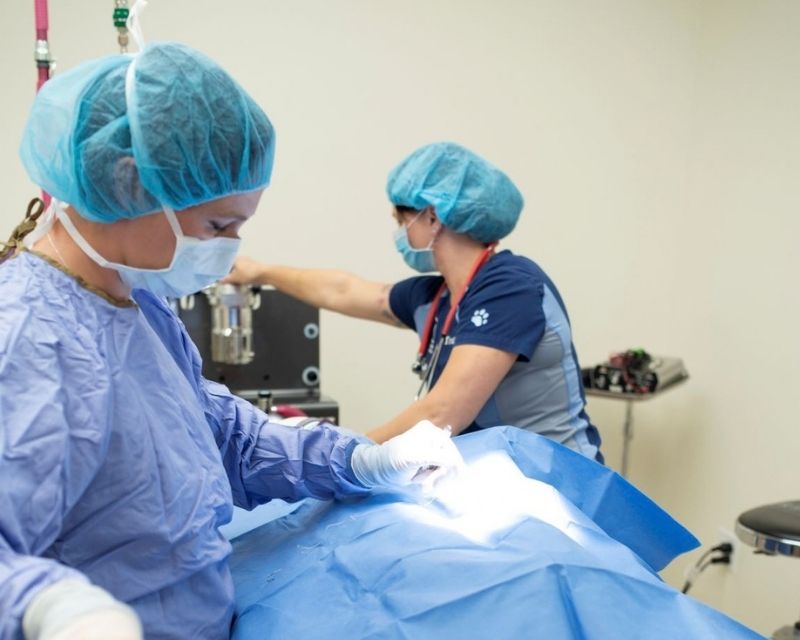
We follow strict protocols and continually monitor your pet’s vital signs to help ensure their safety. Every patient under general anesthesia has an IV catheter in place, and a member of our technical team monitors heart rate, breathing rate, blood oxygen level, blood pressure, and temperature throughout. See our pet anesthesia & monitoring page for the full protocol.
Please contact us if you’d like to discuss how soft tissue surgery might be able to help your pet.